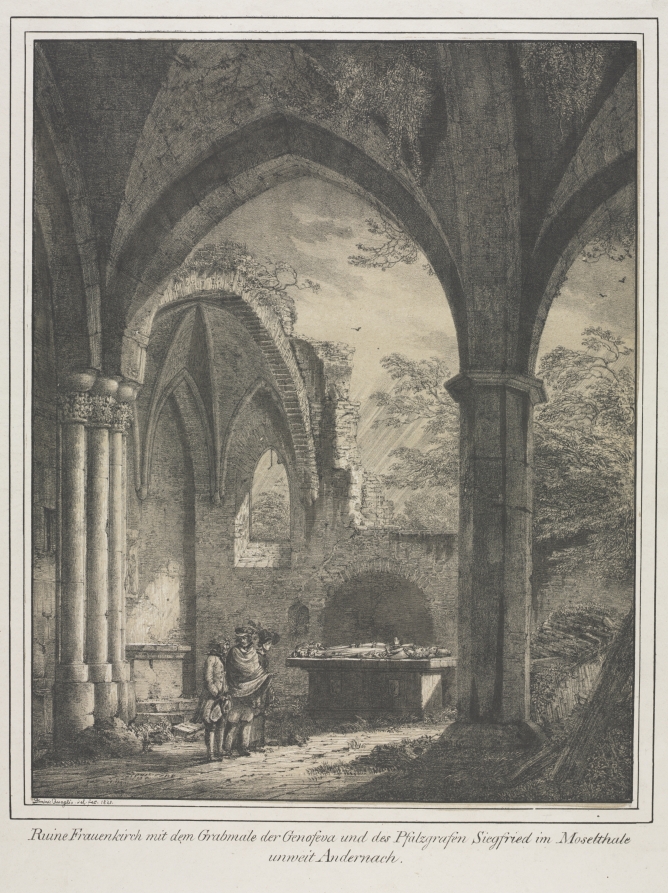
Ruin of the Church of Our Lady with the Tombstones of Genevieve and the Count Palatine Siegfried in the Mosel Valley near Andernach, from Collection of Memorable Medieval Buildings in Germany
SEE IT IN PERSON
Not currently on view
In the collection of Art Institute of Chicago, Chicago · as of July 2026
Discussion
FROM THE ART INSTITUTE OF CHICAGO’S CATALOG
Part of a large Italian artist family recently settled in Munich, Domenico Quaglio was active in Germany for his entire career. Like his father, he initially made his living as a theater scenery painter for the Munich court, and he was even named court painter for architectural scenery by age 21. Leaving Munich to make topographical paintings of sites throughout the country, he was also an adherent of lithography, a relatively new printmaking technique invented in Munich in 1798. Quaglio traveled throughout Central Europe, recording images of churches and castles as prints. Amidst the ruins in this scene are the tombstones of Saint Genevieve and her husband, Siegfried, Count Palatine of the Rhine. Genevieve was wrongly accused of adultery and forced to live in a forest for several years. She survived through her faith until her husband happened across her while hunting. After she convinced Siegfried of her innocence, she returned to Andernach. She had the Church of Our Lady built in the forest where she had stayed in order to show her gratitude to God for keeping her safe.
Be the first to share your thoughts.
Sign in to join the discussion.
More by Domenico Quaglio
 Church of the Pilgrimage in the Tirol
 Chapel of Saint Margaret in the City of Nuremberg, from Coll
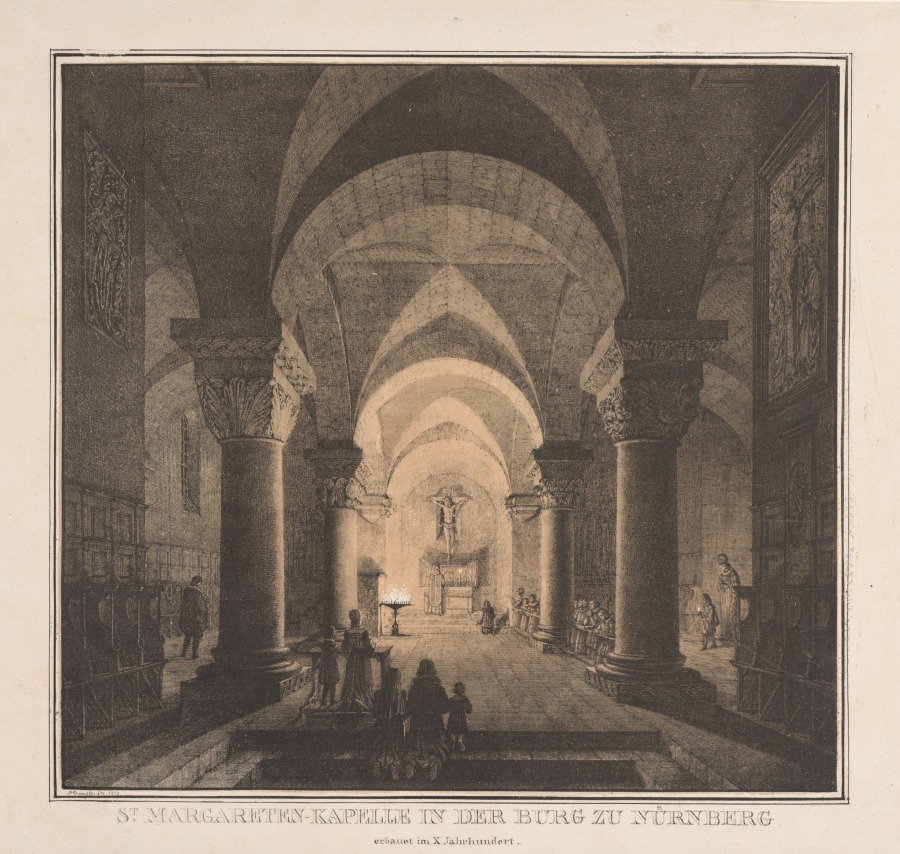 Notable Buildings of the Middle Ages in Germany: St. Margar
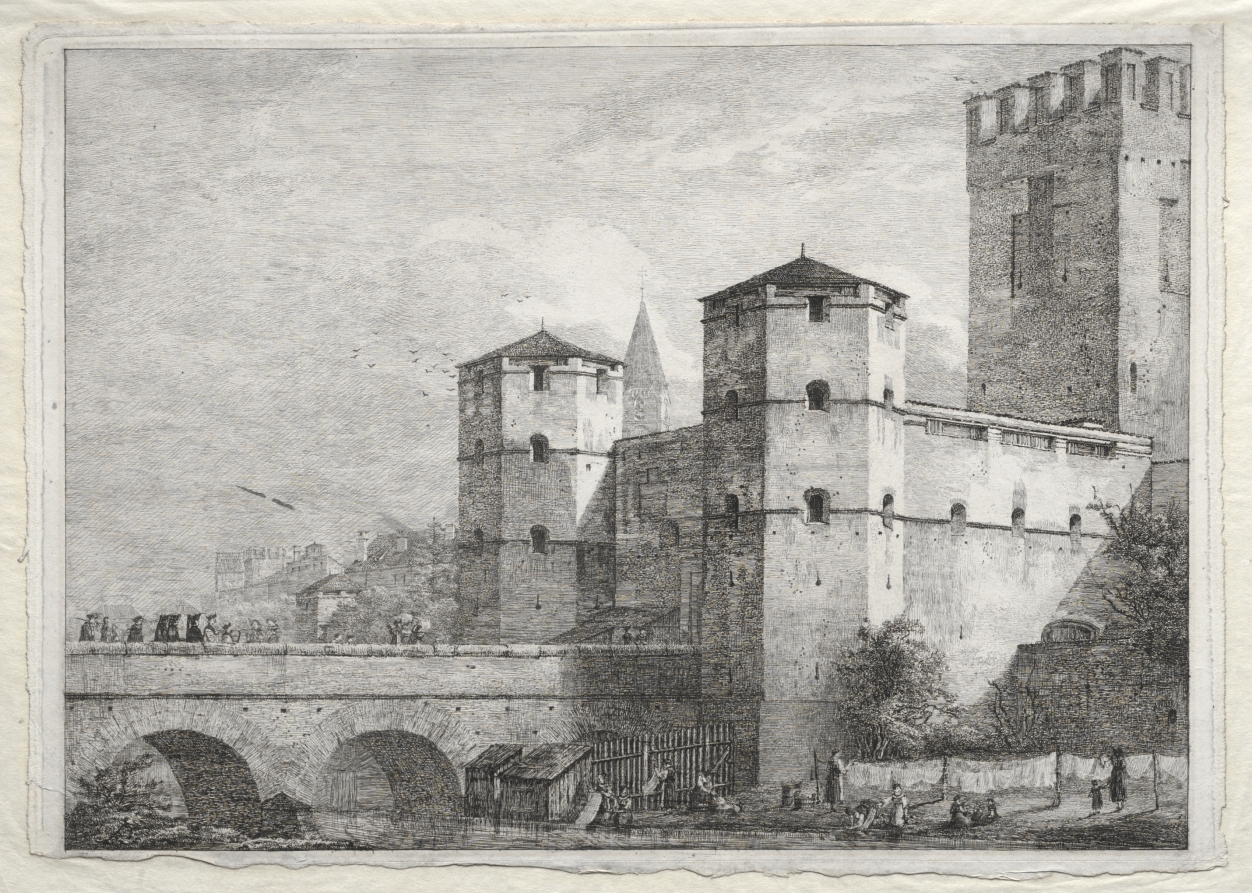 Munich-Hohenschwangau, Bavaria
 Kiderich Church in Rheingau
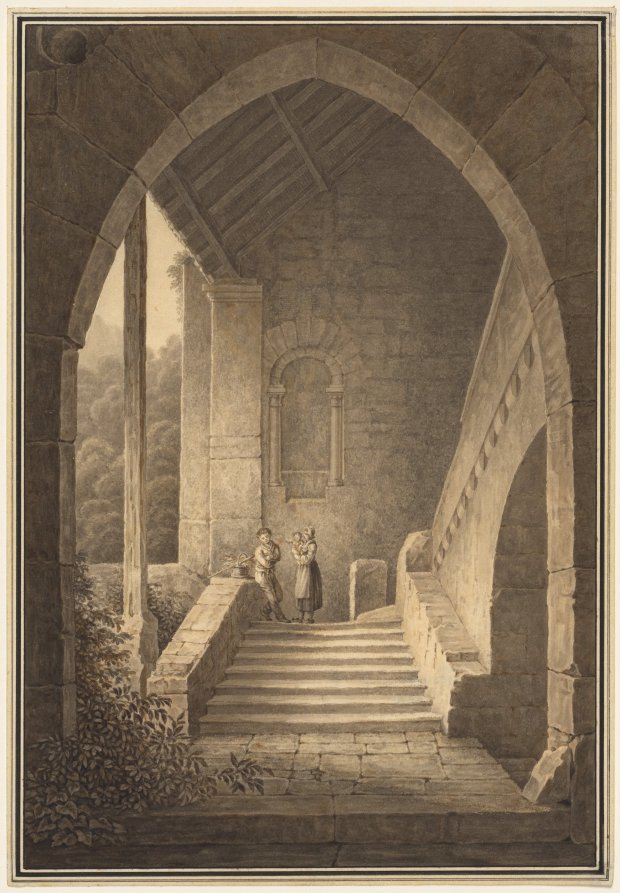 Outer Staircase of a Gothic Ruin
 Münster zu Basel
 Collegiate Church of Our Lady, with Castle Schoenberg at Obe
More like this
 Domenico Quaglio (German, 1787–1837) — Notable Buildings of
  Mauro Berti — Framed Design for a Stage Set with Arches, Sta
 Eugène Cicéri (French, 1813–1890) — Voyages pittoresques et
  John Sell Cotman (British, 1782–1842) — Rievaulx Abbey, York
 Joseph Nash (British, 1808–1878) — Architecture of the Middl
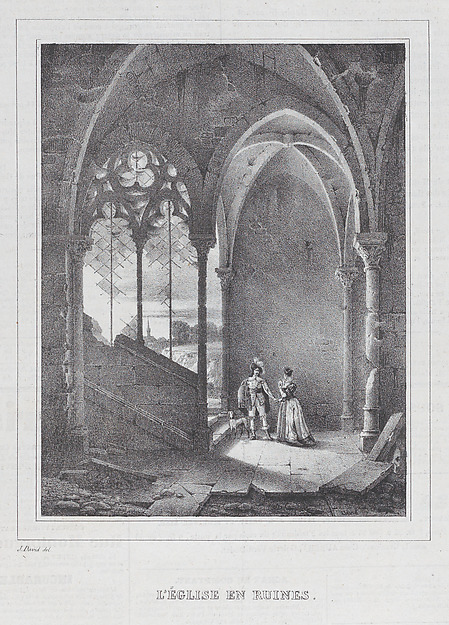 Anonymous|Jules David — L'Eglise en Ruines
![Interior view of the so-called Tempio della Tosse [Temple of the Cough], from Views of Rome](https://www.artic.edu/iiif/2/0737e3b5-1667-6771-bb84-6e7e14bd51c3/full/500,/0/default.jpg) Giovanni Battista Piranesi — Interior view of the so-called
Giovanni Battista Piranesi — Interior view of the so-called  Philipp Veith — Italianate Landscape
 John Cart Burgess — Church Ruins
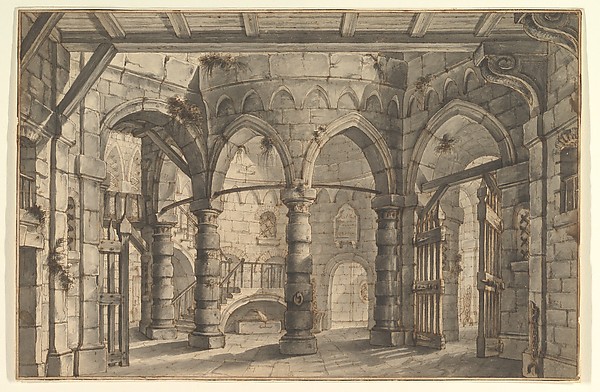 Giovanni Maria Quaglio I (also known as Giulio Quaglio III)
  Albrecht Altdorfer — The Entrance Hall of the Regensburg Syn
 Carl Ludwig Kaaz — Ruins of Birg Castle