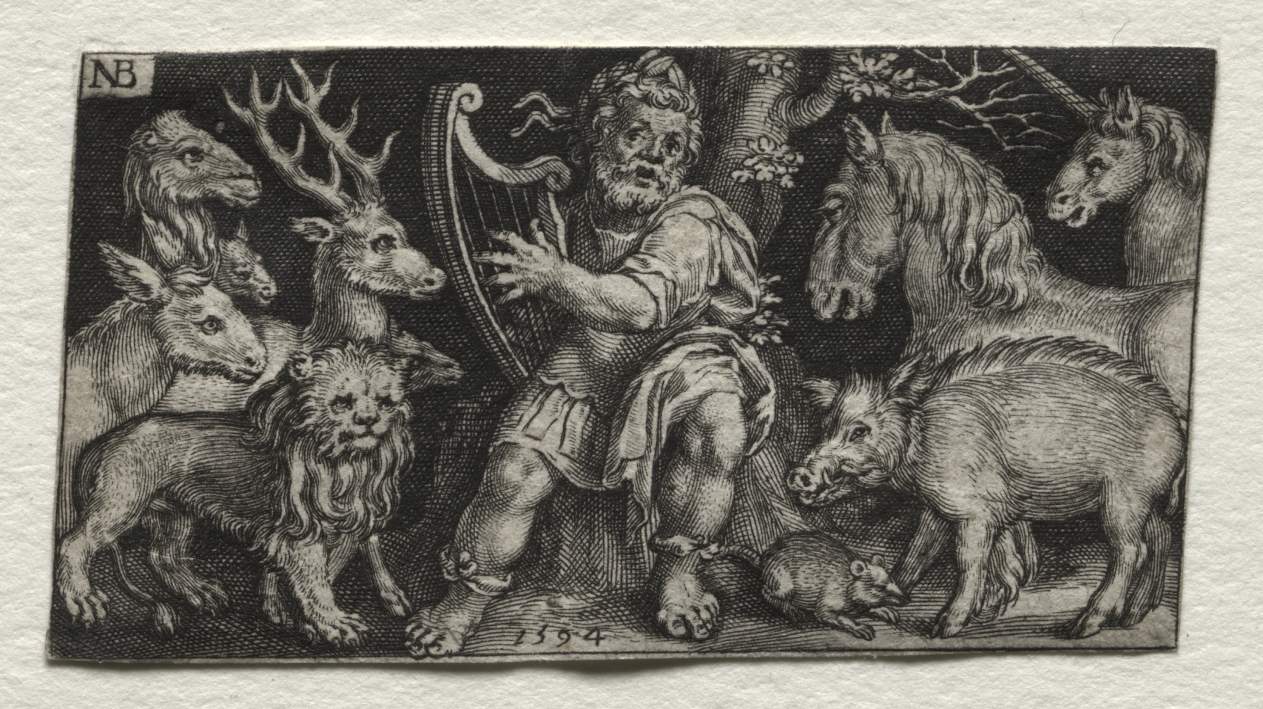
Orpheus Charming the Animals
SEE IT IN PERSON
Not currently on view
In the collection of Art Institute of Chicago, Chicago · as of July 2026
Discussion
FROM THE ART INSTITUTE OF CHICAGO’S CATALOG
As early as the sixth century, Italian silversmiths used an enamel-like, black compound called niello to fill incisions in metal and make their ornamentation visible. Dark backgrounds and pronounced contours are common characteristics of niello plate designs. As paper became more readily available in the 15th century, silversmiths made impressions from the niello plates on sheets to check their progress or record their designs. Growing interest in these small pictures soon led artists to engrave plates for the sole purpose of making prints. Mythological subjects were the most popular niello plates. This print depicts Orpheus, son of the Greek god Apollo, playing music so skillfully that he allures the beasts around him. After the death of his wife, Eurydice, he traveled to the underworld to bring her back. Although he was unsuccessful in his mission, Orpheus became one of a select few who had journeyed to hell and back. For this feat, Dante included Orpheus in the Inferno , among the other ancient poets who reside in limbo.
Be the first to share your thoughts.
Sign in to join the discussion.
More like this
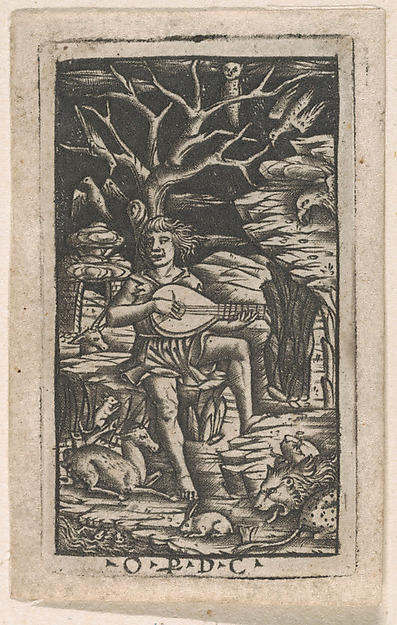 Peregrino da Cesena — Orpheus seated playing his lyre, and c
 Marcantonio Raimondi — Giovanni Filoteo Achillini
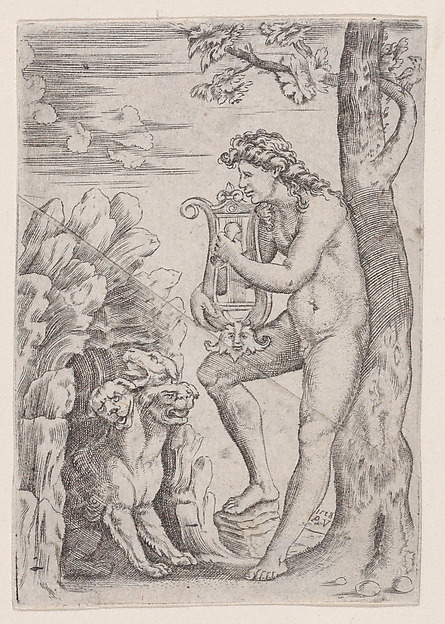 Agostino Veneziano (Agostino dei Musi) — Orpheus
 Lucas Cranach the Elder — A Silver Statuette of an Angel Pla
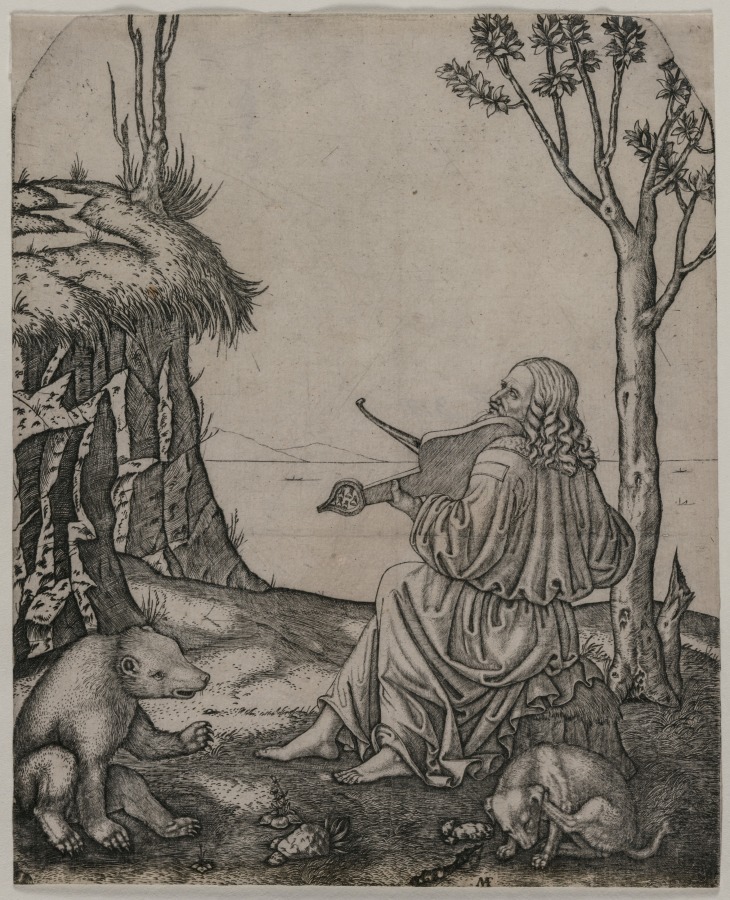 Marcantonio Raimondi (Italian, 1470/82–1527/34) — Orpheus Ch
 Heinrich Aldegrever — Two Musicians Playing the Violin and t
 Agostino Veneziano (Agostino dei Musi)|Baccio Bandinelli — M
 Nicolaes de Bruyn (Netherlandish, 1571–1656) — Orpheus Charm
 Michel Wolgemut — Moses Found by Pharaoh's Daughter (recto)
  Master of the E-Series Tarocchi — Thalia, plate sixteen from
 Hans Baldung (called Hans Baldung Grien) — Title Border with
 Sebald Beham — Woman with a Harp