FROM THE CLEVELAND MUSEUM OF ART’S CATALOG
Although portrait sittings were directed by the photographer, sitters had some input in shaping their identities by choosing their pose, clothing, possessions, and sometimes backdrop. People came to the studio dressed in their finest outfits, and they often brought objects to represent their interests or occupation, such as the tuning fork held by the music teacher. Hand painting could draw attention to luxury items, as in Young Woman with Pantalettes, where her jewelry is dabbed with gold paint and the lacy cuffs of her pantalettes are enhanced with white paint. Most people had only a few photographs made during their lifetimes; therefore, they were often used to mark rites of passage such as graduation and marriage.
Source ↗︎
Be the first to share your thoughts.
![[Two Painters, One Seated and One Standing, with Brushes and a Bucket]](https://images.metmuseum.org/CRDImages/ph/web-large/DP700318.jpg) Unknown — [Two Painters, One Seated and One Standing, with B
Unknown — [Two Painters, One Seated and One Standing, with B![[Two Men in Boxing Stance, a Third Man Adjusting One Man's Form]](https://images.metmuseum.org/CRDImages/ph/web-large/DP700376.jpg) J. C. Batchelder — [Two Men in Boxing Stance, a Third Man Ad
J. C. Batchelder — [Two Men in Boxing Stance, a Third Man Ad![[Two Young Men, One Embracing the Other]](https://images.metmuseum.org/CRDImages/ph/web-large/DP700402.jpg) Unknown — [Two Young Men, One Embracing the Other]
Unknown — [Two Young Men, One Embracing the Other]![[Two Young Men Outdoors, One Seated, the Other on the Arm of the Chair]](https://images.metmuseum.org/CRDImages/ph/web-large/DP700390.jpg) Unknown — [Two Young Men Outdoors, One Seated, the Other on
Unknown — [Two Young Men Outdoors, One Seated, the Other on ![[Two Tinsmiths]](https://images.metmuseum.org/CRDImages/ph/web-large/DP700358.jpg) Unknown — [Two Tinsmiths]
Unknown — [Two Tinsmiths]![[Two Seated Men with Calipers, T-Square, and Compass]](https://images.metmuseum.org/CRDImages/ph/web-large/DP700428.jpg) Unknown — [Two Seated Men with Calipers, T-Square, and Compa
Unknown — [Two Seated Men with Calipers, T-Square, and Compa![[Two Young Men, One Seated and One Standing, Holding Carpentry Tools]](https://images.metmuseum.org/CRDImages/ph/web-large/DP700312.jpg) Unknown — [Two Young Men, One Seated and One Standing, Holdi
Unknown — [Two Young Men, One Seated and One Standing, Holdi![[Three Painters, with Brushes and a Can of Paint, in Front of a Painted Window Backdrop]](https://images.metmuseum.org/CRDImages/ph/web-large/DP700320.jpg) Unknown — [Three Painters, with Brushes and a Can of Paint,
Unknown — [Three Painters, with Brushes and a Can of Paint, ![[Two Young Men in Straw Hats, One Seated in the Other's Lap]](https://images.metmuseum.org/CRDImages/ph/web-large/DP700392.jpg) Unknown — [Two Young Men in Straw Hats, One Seated in the Ot
Unknown — [Two Young Men in Straw Hats, One Seated in the Ot![[Carpenter with Saw, Hammer, and Jointer]](https://images.metmuseum.org/CRDImages/ph/web-large/DP700436.jpg) Unknown — [Carpenter with Saw, Hammer, and Jointer]
Unknown — [Carpenter with Saw, Hammer, and Jointer]![[Workman Holding a Wrench and Hammer]](https://images.metmuseum.org/CRDImages/ph/web-large/DP700415.jpg) Unknown — [Workman Holding a Wrench and Hammer]
Unknown — [Workman Holding a Wrench and Hammer]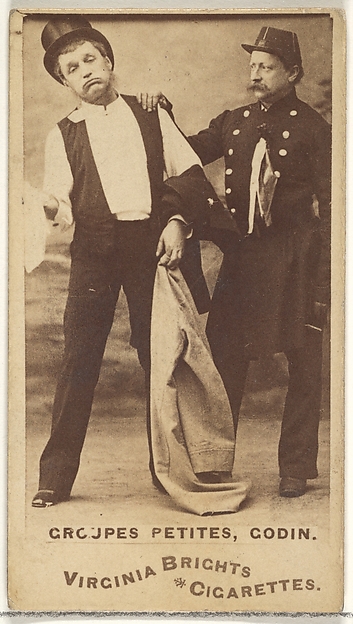 Allen & Ginter — Groupes Petites, Godin, from the Actors and