Telemachus is Consoled by Termosiris, Priest of Apollo, from The Adventures of Telemachus, Book 2
SEE IT IN PERSON
Not currently on view
In the collection of Art Institute of Chicago, Chicago · as of July 2026
Discussion
FROM THE ART INSTITUTE OF CHICAGO’S CATALOG
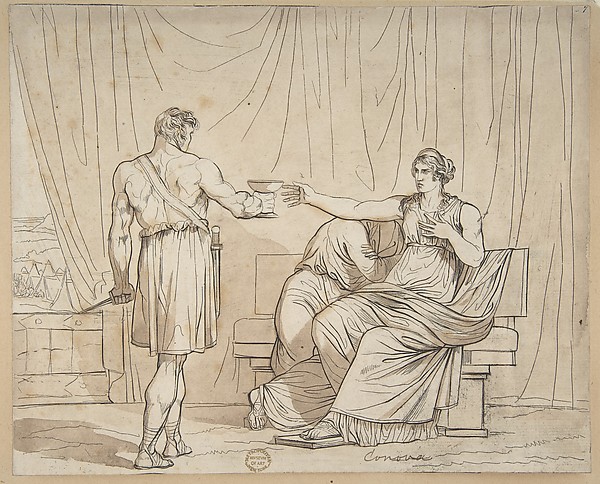
These twelve drawings depict scenes from the French novel The Adventures of Telemachus (Les aventures de Télémaque) by François Fénelon. First published in 1699, it was one of the most popular books of the 1700s and 1800s. Telemachus is the son of Ulysses from Homer’s Odyssey , the first four books of which describe the hero’s search for his father. Fénelon invented further adventures for Telemachus, in which he undergoes many trials while accompanied by his tutor, Mentor, who is actually the goddess Minerva (the embodiment of wisdom) in human disguise. A scathing critique of autocratic government and a diatribe against war, the book denounces luxury and decadence and calls for the simplicity and equality Fénelon believed ancient Greece best exemplified. Pinelli illustrated scenes from books 1–8 and one scene from book 18, and probably planned to illustrate more from the 24 books of the text. Throughout, he celebrates the heroic nude, displaying a deep knowledge of ancient Roman sculpture. His style, influenced by Jacques-Louis David and John Flaxman, is characterized by bold, almost cartoonish contours, monochromatic washes, and frieze-like arrangements of figures. The Phoenician
Be the first to share your thoughts.
Sign in to join the discussion.
More by Bartolomeo Pinelli




More like this
 Giovanni Battista Cipriani — Ulysses and Nausicaa
 Charles Joseph Natoire|Etienne Fessard — The Chapel of the E
 Carl Baron von Vittinghoff — The Shepherd Finding Romulus ne
 Adrian Zingg (Swiss, 1734–1816) — I was also in Arcadia (Kai
 Pietro Monaco|Francesco Maffei — Job rebuked by his wife
 Nicholas Verkolje — Christ and the Woman of Samaria
 Gerard de Lairesse|Anonymous, Italian, 17th century|Anonymou
 Salvator Rosa — Apollo and the Cumaean Sibyl
 Unknown — Mercury and Argus
 Jan Saenredam — Ahajah Divides his Cloak into Twelve Parts,
  Godfried Maes — Illustrations to the Metamorphoses of Ovid:
  Gerrit Claesz. Bleker (Dutch, 1656) — An Angel Foretells the