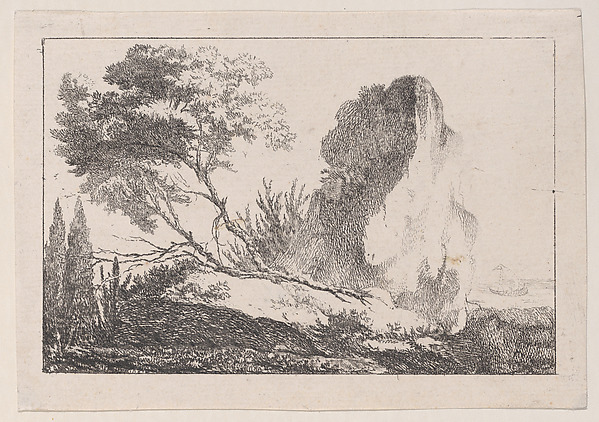
Landscape
SEE IT IN PERSON
Not currently on view
In the collection of Art Institute of Chicago, Chicago · as of July 2026
Discussion
FROM THE ART INSTITUTE OF CHICAGO’S CATALOG
Henry Richard Greville was not a professional printmaker, but rather one of many aristocrats who pursued lithography as a hobby. Lithography depends upon the antipathy of grease and water, so a lithographer draws on a smooth block of limestone in a greasy medium—crayon or a liquid wash called tusche. When printing ink is applied to the wet stone, it only sticks to the drawn lines. The first collection of lithographs, or polyautographs, Specimens of Polyautography , was published in London in 1801 with pen lithographs by several well-known English artists. After this early start, lithography failed to catch on in England, however, leaving French artists to explore the full range of possibilities of the medium.
Be the first to share your thoughts.
Sign in to join the discussion.
More like this
 Jean Baptiste Huet — Plate 23 of 38 from Oeuvres de J. B. Hu
 Jean Baptiste Huet — Plate Six of 38 from Oeuvres de J. B. H
 Anonymous, Italian, Venetian, 15th to 16th century — Trees
 Henry Richard Greville, 3rd Earl of Warwick and Brooke — Lan
 Jan Both — The Large Tree, from Upright Italian Landscapes
 Jan Both — Upright Italian Landscapes: Woman on a Mule
 Carl Wilhelm Kolbe, the elder — Landscape
 Étienne de Lavallée-Poussin — Mary Magdalene as a Penitent
 Ferdinand Kobell — Waterfall (The Cascade)
 Herman Naijwincx — Mountainous Landscape with a Road, from t
 Jean Baptiste Huet — Bucolic Scene
 Louis Philippe Joseph, duc de Chartres — Landscape