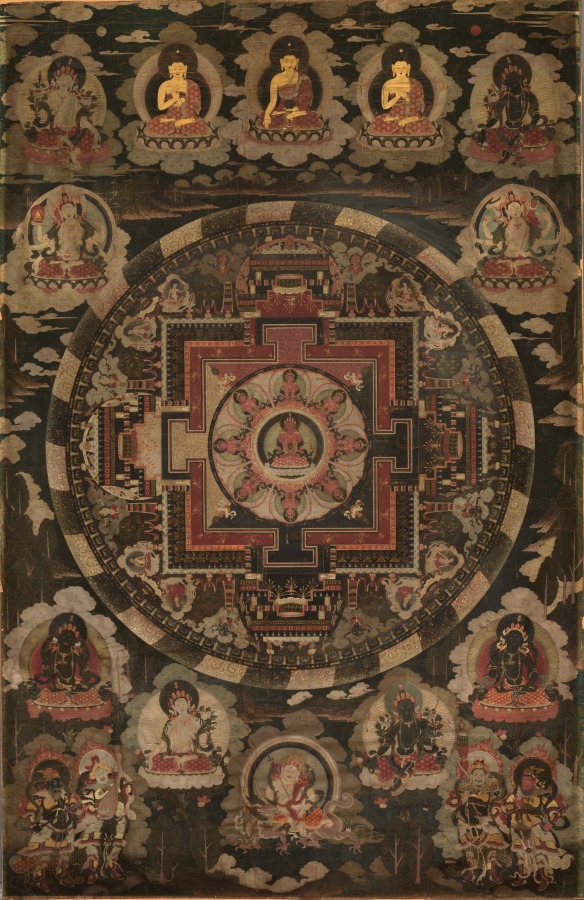
Tiered Offering Mandala of the Goddess of Wealth (Vasudhara)
SEE IT IN PERSON
Not currently on view
In the collection of Art Institute of Chicago, Chicago · as of July 2026
Discussion
FROM THE ART INSTITUTE OF CHICAGO’S CATALOG
Vasudhara—the goddess from whom wealth ( vasu ), gems, abundance, and well-being flow ( dhara )—presides at the center of this multitiered mandala (a graphic symbol of the universe). When a deity appears at the center of a mandala, it serves as a reminder to the devotee of the god’s presence in the cosmos, as well as to the fact that the god is the cosmos. Here the concept is expressed by a mandala of three concentric outer circles rising to the space of the square. Identifiable by the pot of life-giving water in her lower-left hand and the gesture of boon granting ( varadamudra ) of her lower-right hand, Vasudhara also has traits that distinguish her as Nepalese: her six encircling arms and the graceful lalitasana pose, with one leg pendent and the other tucked beneath her. (In India and Tibet, she is often shown standing and with two arms.) The goddess’s complexion is depicted as golden in sculpture and yellow in painting, a symbol of her wealth-giving attributes. Vasudhara is especially popular with the Buddhist Newari people of the Kathmandu Valley in Nepal, who would probably have used an object such as this for rituals dedicated to the goddess in either a temple or the home.
Be the first to share your thoughts.
Sign in to join the discussion.
More by Nepal
 Krishna's Marriage to Kalinda, page from a Dispersed Bhagava
 Pradyumna Enters the Palace of the Demon Sambar and Challeng
 Rukmini Seeks Krishna's Permission to Visit her Brother Rukm
 The Demon Sambar Throws the Infant Pradyumna into the River,
 Arjuna Slays Karna, page from a Mahabharata series
 Head of Bhairava, A Horrific Form of God Shiva
 One of a Pair of Magical Charms (Dharani) Manuscript Covers
 Bodhisattva Avalokiteshvara Seated with Hand in Gesture of R
More like this
 Tibet — Plaque of Vajrasattva
 Japan — Icon Plaque (Kakebotoke) with Bosatsu
 China — Amitayus (Adorned Buddha)
 India — Altarpiece with the First Jaina Tirthankara Rishabha
 Tibeto-Chinese — Deity from a Set of Five Pancharaksha Godde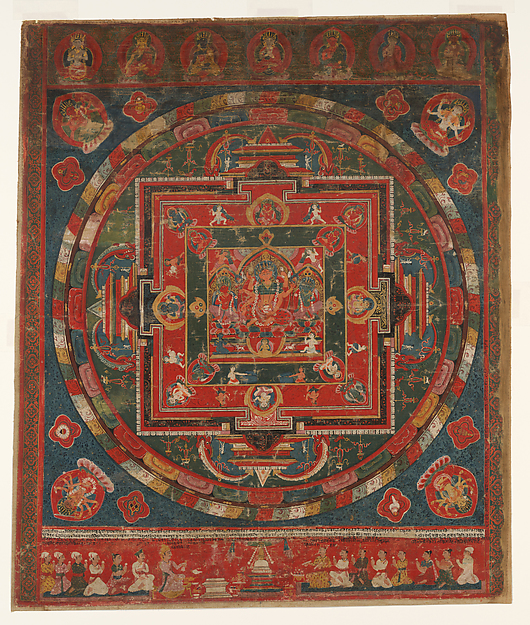
 Mandala of Chakrasamvara and Vajravarahi
 Nepal
Kathmandu Valley — Votive Plaque with God Vishnu
Nepal
Kathmandu Valley — Votive Plaque with God Vishnu China — One of the Five Celestial Buddhas, Seated with Hands
 Mandala