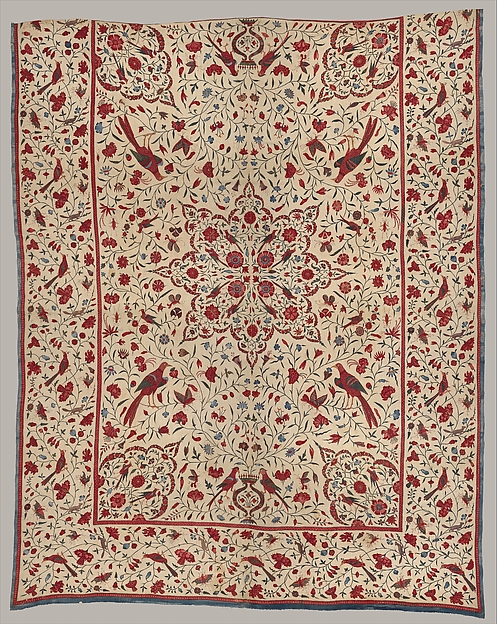
Suzani (large hanging or cover)
SEE IT IN PERSON
● On view now — Gallery 59
Art Institute of Chicago, Chicago · verified July 2026
Discussion
FROM THE ART INSTITUTE OF CHICAGO’S CATALOG
Densely embroidered with colorful silk threads, this lush hanging or cover exemplifies suzani textiles produced during the latter half of the nineteenth century in eastern Uzbekistan, particularly near the oasis cities of Bukhara and Kokand. Art historians and collectors use the term "suzani" to describe a family of embroidered textiles made in Central Asia by urban dwelling Uzbek and Tajik women. During the nineteenth century, young women in particular embroidered hangings and covers as well as other household linens for their dowry. The design and embroidery of a suzani usually involved a number of steps. The pieced, plain woven cotton cloth that serves as the ground fabric for the embroidery was purchased in a single length, then cut and stitched together to produce a large rectangular panel upon which a designer, known as a kalamkash , could draw the pattern. To complete the embroidery, the embroiders agreed on the colors for the different parts of the design, the lengths were unstitched, and then each embroiderer worked carefully on her own to complete her panel. When the embroiderers finished the panels, they once again were stitched together to produce a finished o
Be the first to share your thoughts.
Sign in to join the discussion.
More like this
 Turkey — Cover
 Turkey — Cover
 Anonymous — Panel
 Iran (Persia) — Fragment (From a shawl)
 Turkey — Cover
 Iran (Persia) — Fragment (From a shawl)
 India, Coromandel Coast (?)
Found in the Toraja area of Sula
India, Coromandel Coast (?)
Found in the Toraja area of Sula Iban — Ceremonial Cloth (Pua sungkit)
 Iran (Persia) — Panel (From Woman's Trousers)
 Turkey — Cover
 Islamic — Prayer Carpet
 Hanging