The Essex Canal
SEE IT IN PERSON
Not currently on view
In the collection of Art Institute of Chicago, Chicago · as of July 2026
Discussion
FROM THE ART INSTITUTE OF CHICAGO’S CATALOG
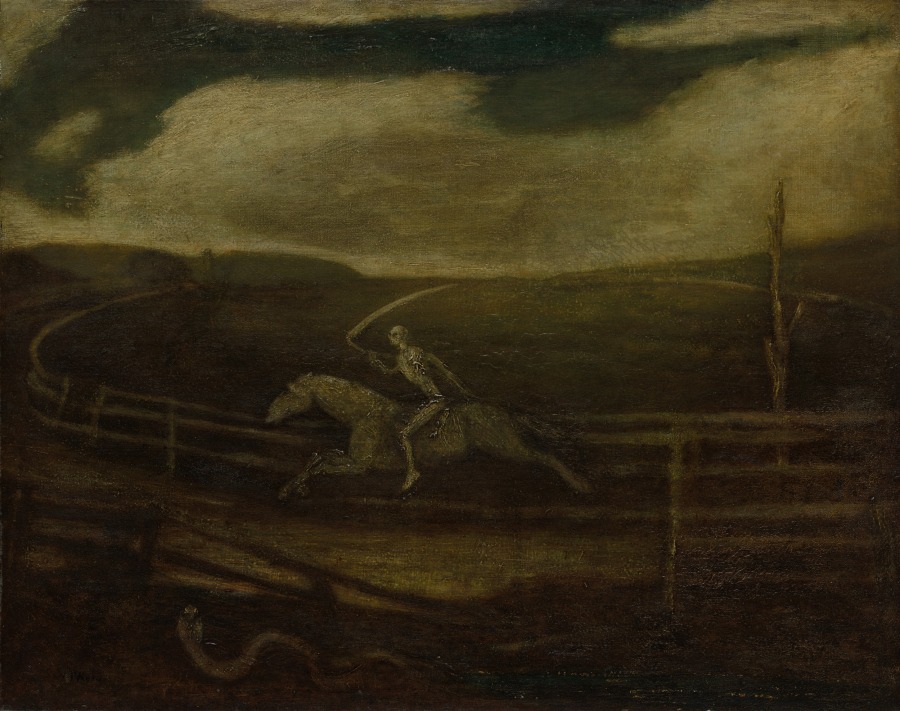
Albert Pinkham Ryder was one of the most innovative artists of the late 19th century, creating reductive, yet expressive compositions out of thick, slowly worked paint, combined with glazes, varnishes, and unconventional materials. In The Essex Canal , a waterway faintly meanders from the green-hued foreground to a skim of blue along the horizon, with an expansive sky beyond. A younger generation of American artists celebrated Ryder as an important early modernist, who pushed toward abstraction and focused on the arduous process of painting itself as instrumental to one’s creative vision. Ryder’s reclusiveness only added to his intrigue and mythic status as an artist ahead of his time.
Be the first to share your thoughts.
Sign in to join the discussion.
More by Albert Pinkham Ryder
More like this
 Ralph A. Blakelock (American, 1847–1919) — Indian Camp
 Théodore Rousseau — Landscape
 William Keith — Landscape
 Rudolf Jurriaan Stephanus Haak — Evening Sun
 John Constable (British, 1776–1837) — Hampstead Heath
 Constant Troyon — A Clump of Trees
 Gustave Courbet — Wooded Landscape
 William Keith — Landscape
 Carl Rottmann (German, 1797–1850) — Epidauros
 Lockwood de Forest — Greek Mountain Peak at Twilight
 Homer Dodge Martin (American, 1836–1897) — Near Newport
 Unknown artist — River in Rocky Valley