Act 9 (Kyudanme), from the series "The Revenge of the Loyal Retainers (Chushingura)"
c. 1834/39
Color woodblock print; oban
24.5 × 37 cm (9.6 × 14.6 in)
SEE IT IN PERSON
Not currently on view
In the collection of Art Institute of Chicago, Chicago · as of July 2026
Discussion
FROM THE ART INSTITUTE OF CHICAGO’S CATALOG
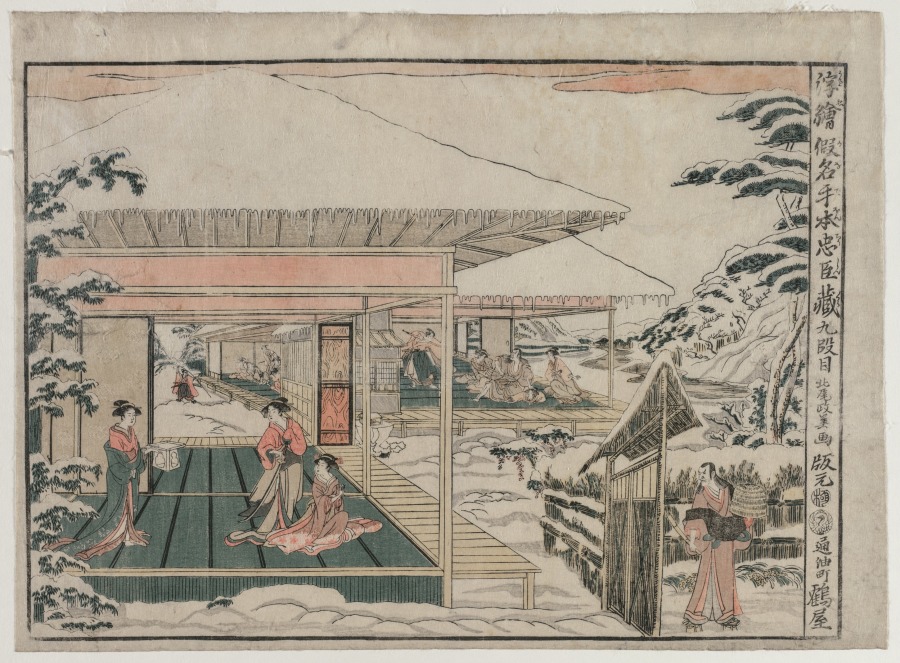
In the open room at Yamashima, Honzo has committed seppuku in the presence of his wife and daughter. This is in atonement for his past support of Kira, which greatly contributed to Asano’s death and reduced his retainers to ronin outcasts. In the snow-covered courtyard, Kuranosuke dons the Buddhist monk disguise, which other artists show Honzo wearing on his arrival at Yamashima. Kuranosuke leaves his weeping wife and son Rikiya kneeling in the snow to go to Sakai to complete the plans for attacking Kira.
Be the first to share your thoughts.
Sign in to join the discussion.
More by Utagawa Hiroshige
 歌川広重画 「東海道五十三次 大尾 京師 三条大橋」|Kyoto: The Great Bridge at Sanjō
  Opening of the Garden at Fukagawa Hachiman Shrine (Fukagawa
  東海道五十三次之内 阪之下 筆捨嶺|Saka-no-shita, Fude-sute Mine
 Kumano Junisha Shrine in Tsunohazu, Popularly Known as Junis
 Gotenyama no yu-zakura|東都名所 御殿山之夕桜|Evening Cherry Blossoms a
 Sakanoshita: Peak of Fudesute Mountain (Sakanoshita, Fudesut
 Maisaka: View of Imagiri (Maisaka, Imagiri shinkei), from th
 Inume Pass in Kai Province (Kai Inume toge), from the series
More like this
 Kitagawa Utamaro (Japanese, 1753?-1806) — Elegant Pleasures
  Utagawa Toyokuni I — The actors Seki Sanjuro II, One Kikugor
 Utagawa Hiroshige (Japanese, 1797–1858) — The Snowy Garden
 Katsukawa Shunsho — The Actors Arashi Sangoro II as Minamoto
 Kitagawa Utamaro — New Year in a Samurai Mansion, from the i
 Kitao Masayoshi (Japanese, 1761–1824) — Chushingura: Act IX
  Katsushika Hokusai — Plum Garden (Umeyashiki), from vol. 1 o
 Katsushika Hokusai (Japanese, 1760–1849) — Poem by Emperor S
 Torii Kiyonaga — Opening the Storehouse (Kurabiraki), from t
 Suzuki Harunobu — Ebisu, from the series "The Seven Gods of
  Utagawa Kuniyoshi (Japanese, 1797–1861) — Odawara Station: M
 Katsushika Hokusai — Pages from the illustrated book "Panora