Border with Rosettes and Oak Leaves
SEE IT IN PERSON
Not currently on view
In the collection of Art Institute of Chicago, Chicago · as of July 2026
Discussion
FROM THE ART INSTITUTE OF CHICAGO’S CATALOG
The late 18th and early 19th centuries were an incredibly fertile period for innovation in the European textile industries, especially in the field of direct printing. Decades of experimentation led to the development of a variety of ways to apply color and pattern to cloth, which enabled artists and designers to invent new design vocabularies and quickly respond to cultural trends and ideas. One of the most enduring of these innovations was the ability to print on cloth with copperplates and then subsequently with engraved copper metal rollers. The quality of detail achieved through this method was unrivaled in terms of clarity, precision.
Be the first to share your thoughts.
Sign in to join the discussion.
More by French
 Head of a Woman
 Altarpiece from Thuison-les-Abbeville: Saint Hugh of Lincoln
 Panels from the High Altar of the Charterhouse of Saint-Hono
 Portrait of a Young Man
 Altarpiece from Thuison-les-Abbeville: Saint Honoré
 Altarpiece from Thuison-les-Abbeville: The Ascension
 Panels from the High Altar of the Charterhouse of Saint-Hono
 The Nymph of Fontainebleau
More like this
 Italy — Border
 John Munns — Valance (Furnishing Fabric)
 Rongkong — Ceremonial Textile (mbesa tali tau batu or pewo)
 Islamic — Scroll with Arabic text giving the story of the Sh
 Italy, Florence — Panel from the Davanzati Palace
 Probably Kashmir for the Persian market (present-day Iran) —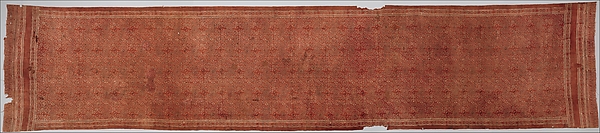
 Turkey — Fragment
 Mathevon et Bouvard — Panel
 William Morris — Wey
 Italy — Fragment
 Italy — Fragment