Untitled (Ceylon)
SEE IT IN PERSON
Not currently on view
In the collection of Art Institute of Chicago, Chicago · as of July 2026
Discussion
FROM THE ART INSTITUTE OF CHICAGO’S CATALOG
Julia Margaret Cameron gained renown for documenting "famous men and fair women" of her day, producing portraits and allegorical groups that were widely admired for their intimacy and emotional depth. In 1875, straitened financial circumstances forced her from her comfortable home on the Isle of Wight, where she was close to many luminaries of Victorian England to the family's coffee plantation in Ceylon. Cameron became enthralled with what she called "the primitive simplicity of the inhabitants," although she concentrated on only a few models—the Tamil women posing here were most likely maidservants working on her plantation. Beset by technical difficulties resulting from the warm and humid climate, and deprived of the audience she had had in England, Cameron produced but few photographs in these final years in Ceylon.
Be the first to share your thoughts.
Sign in to join the discussion.
More by Julia Margaret Cameron
![[Mary Ryan]](https://images.metmuseum.org/CRDImages/ph/web-large/DP295257.jpg)




More like this
![[Two Indian Women, One Seated]](https://images.metmuseum.org/CRDImages/ph/web-large/DP147801.jpg) Unknown — [Two Indian Women, One Seated]
Unknown — [Two Indian Women, One Seated]![[Two Women]](https://images.metmuseum.org/CRDImages/ph/web-large/DP138842.jpg) Ernest Benecke — [Two Women]
Ernest Benecke — [Two Women]![[Two Hindu Women in Elaborate Jewelry, Before Studio Backdrop with Palm Trees]](https://images.metmuseum.org/CRDImages/ph/web-large/DP71250.jpg) Unknown — [Two Hindu Women in Elaborate Jewelry, Before Stud
Unknown — [Two Hindu Women in Elaborate Jewelry, Before Stud![[Three East Indian Women]](https://images.metmuseum.org/CRDImages/ph/web-large/DP116352.jpg) Francis Frith — [Three East Indian Women]
Francis Frith — [Three East Indian Women]![[A Gypsy Dancing-Girl, Kathiawar]](https://images.metmuseum.org/CRDImages/ph/web-large/DP71244.jpg) E. Taurines — [A Gypsy Dancing-Girl, Kathiawar]
E. Taurines — [A Gypsy Dancing-Girl, Kathiawar] Scowen & Co. (British, active Ceylon, 1876–1895) — Ceylonese
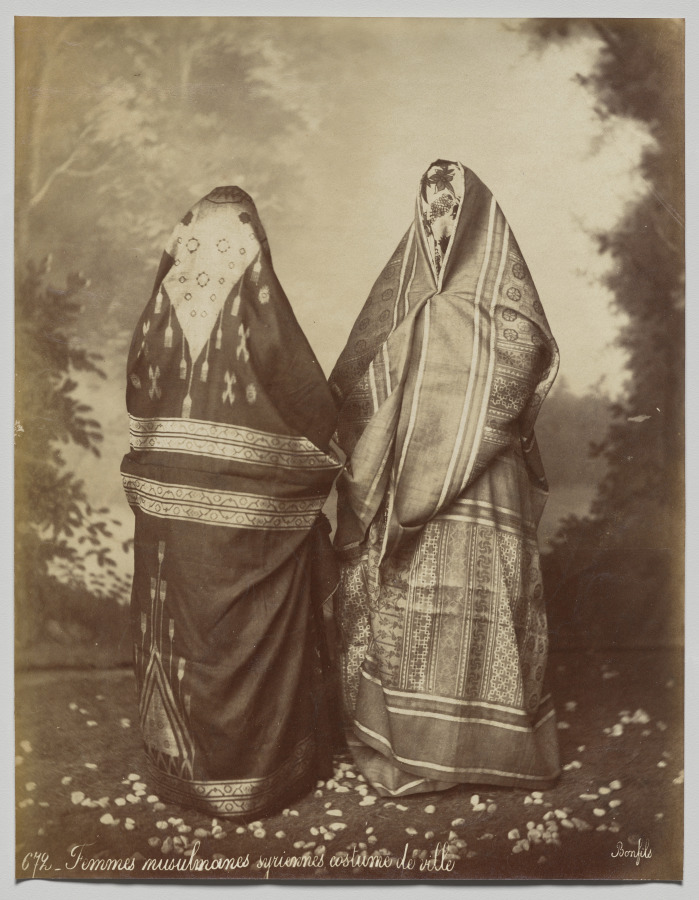 Félix Bonfils (French, 1831–1885) — Femmes musulmanes Syrien
![[Girl with a Sitar]](https://images.metmuseum.org/CRDImages/ph/web-large/DP147404.jpg) Unknown — [Girl with a Sitar]
Unknown — [Girl with a Sitar]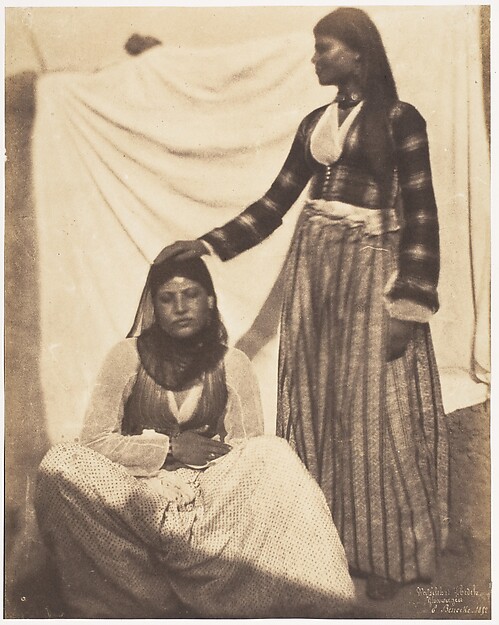 Ernest Benecke — Wassileh and Lhedeh, Ghawagea
![[Old Man and Women with Children, One Nursing]](https://images.metmuseum.org/CRDImages/ph/web-large/DP71258.jpg) Unknown — [Old Man and Women with Children, One Nursing]
Unknown — [Old Man and Women with Children, One Nursing]![[Two Gypsy Women]](https://images.metmuseum.org/CRDImages/ph/web-large/DP71133.jpg) Unknown — [Two Gypsy Women]
Unknown — [Two Gypsy Women] Ernest Benecke — Egyptian Musicians (Rawabí) and Almée