Shawl Border (Pallu)
SEE IT IN PERSON
Not currently on view
In the collection of Art Institute of Chicago, Chicago · as of July 2026
Discussion
FROM THE ART INSTITUTE OF CHICAGO’S CATALOG
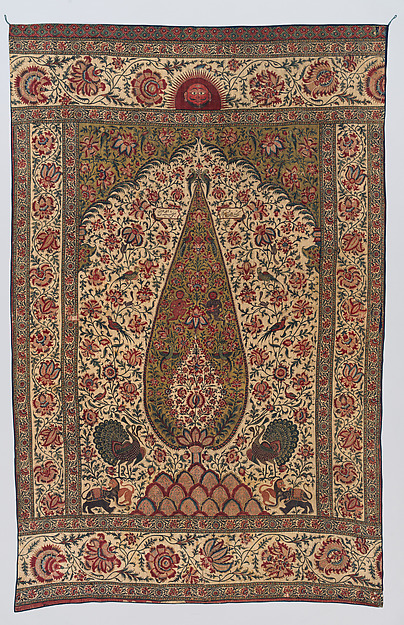
The earliest Kashmir shawls introduced to Europe were made of white cashmere wool with decorated ends containing rows of stylized floral buta motifs. The pattern became known as paisley in English, after the town in Scotland that was a center of shawl weaving. The fine wool of a shawl’s central area was always the most fragile component, and this long shawl has been mended with two nearly invisible seams across the central white field. Europeans valued Kashmir shawls so highly that even fragments of the decorative borders were preserved, collected, and treasured.
Be the first to share your thoughts.
Sign in to join the discussion.
More by India, Kashmir

More like this
 Kashmir — Pallu (Shawl Border) Fragment
 India — Fragment (Shawl Border)
 Indonesia, Central Java — Slendang (Shawl)
 Indonesia, Central Java — Slendang (Shawl)
 Gujurat, India — Patolu
 India — Shawl Border Fragment
 Iran (Persia) — Fragment (From a shawl)
 India, Gujarat
Found in the Toraja area of Sulawesi, Indones
India, Gujarat
Found in the Toraja area of Sulawesi, Indones Indonesia, Java — Slendang (Shawl)
 Kalamkari
 India
Exported for the Sri Lankan market — Length of Chintz
India
Exported for the Sri Lankan market — Length of Chintz Indonesia, Java — Slendang (Shawl)