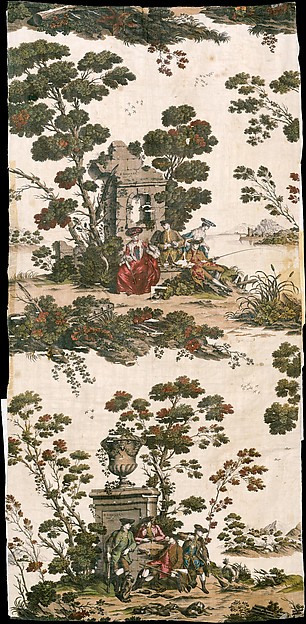
Panel (Furnishing Fabric)
SEE IT IN PERSON
Not currently on view
In the collection of Art Institute of Chicago, Chicago · as of July 2026
Discussion
FROM THE ART INSTITUTE OF CHICAGO’S CATALOG
The historical significance of this panel comes not from its representation but from its precise documentation in textile history. It is one of the earliest examples using copper plate printing, signed and dated in the plate in two places. the pastoral scene is from an etching by Nicholas Berchem (1620- 1683), dating from 1652; the peacock and poultry still life can be traced to an engraving by Josephus Sympson (1710- 1750) published in London in 1740, after a painting by Marmaduke Cradock (1660- 1717). The columns are emblematic of the classical- revival style favored at the time and the stag and dog motifs can be traced to the volume entitled "Animals of Various Species Accurately Drawn" by Francis Barlow (1626- 1702).
Be the first to share your thoughts.
Sign in to join the discussion.
More by Robert Jones
More like this
 Jean Baptiste Huet — Le Parc du Chateau (Furnishing Fabric)
 France — Fragment
 Jean Baptiste Huet — Les Travaux de la Manufacture (The Fact
 Jean Baptiste Huet — L'Escarpolette (Furnishing Fabric)
 Petitpierre Frères & Cie. — L'Agréable leçon (The Pleasant L
 England — Commedia del'Arte (Furnishing Fabric)
 France — Fragment
 Louis Charles Ruotte — Louis XIV and Mademoiselle de La Vall
 Robert Edge Pine — Garrick and Shakespeare with Tragedy and
  Robert Edge Pine — Garrick and Shakespeare with Tragedy and
  Flanders or Netherlands — Napkin
 Bannister Hall Print Works — Panel (Furnishing Fabric)