Israhel van Meckenem, the younger
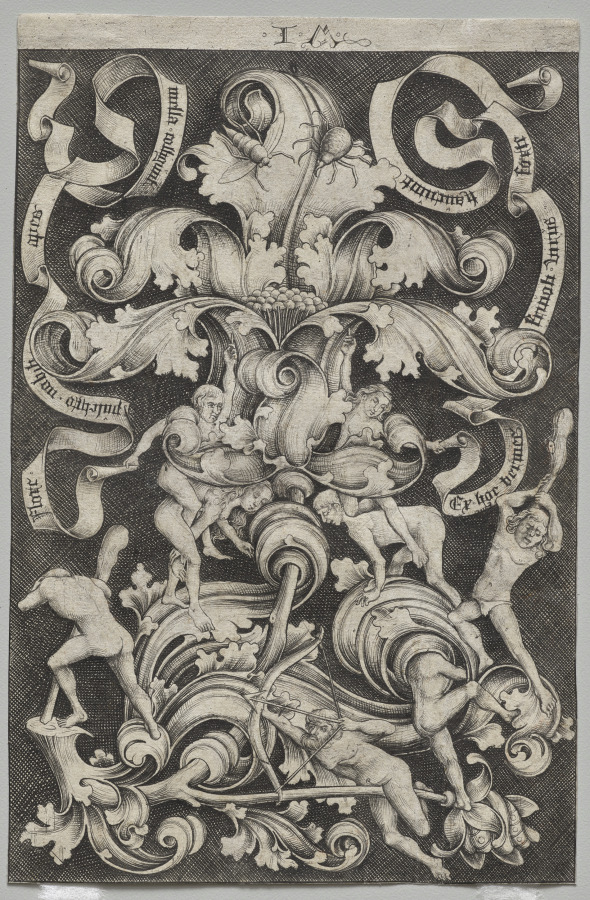
Ornament With Flower and Eight Wild Folk
SEE IT IN PERSON
Not currently on view
In the collection of Art Institute of Chicago, Chicago · as of July 2026
Discussion
FROM THE ART INSTITUTE OF CHICAGO’S CATALOG
Ornament prints with mischievous tiny figures were in such demand in late-15th- and early-16th-century Europe that engravers like Israhel van Meckenem frequently borrowed imagery and entire compositions from other artists. The flower stalk that the naked wild men and women scale comes from a print by an earlier artist, the Master E. S. This print bears an inscription that translates to “The noble bees draw honey from the beautiful flower; from this one however, the frivolous vermin extract a stronger potion.” The ripe blossom thus symbolizes sexual consummation, and the print simultaneously tempts and warns the viewer about “the birds and bees.”
Be the first to share your thoughts.
Sign in to join the discussion.
More by Israhel van Meckenem, the younger


More like this
 Israhel van Meckenem (German, c. 1440–1503) — Upright Orname
 Master of the Die|Perino del Vaga (Pietro Buonaccorsi) — A p
 Martin Schongauer — Ornament with Owl Mocked by Day Birds
 Wendel Dietterlin — Fantastic Architecture, plate 36 (later
  Antonio Fantuzzi — Ornament Panel with Terms and Spiral Base
 Agostino Veneziano (Agostino dei Musi)|Raphael (Raffaello Sa
 Lucas van Leyden (Netherlandish, 1494–about 1533) — Panel of
 Master of the Die|Perino del Vaga (Pietro Buonaccorsi)|Anton
 Heinrich Aldegrever — Vertical Panel with Candelabrum Grotes
 Nicoletto da Modena — Vertical ornament panel with Mars
 Albrecht Altdorfer — Ornamental Design with an Angels Head a
 Master of the Die|Perino del Vaga (Pietro Buonaccorsi)|Anton