Casket
SEE IT IN PERSON
Not currently on view
In the collection of Art Institute of Chicago, Chicago · as of July 2026
Discussion
FROM THE ART INSTITUTE OF CHICAGO’S CATALOG
This small casket or strongbox with its handle and locking mechanism was well designed for the restless, mobile nature of French court life in the sixteenth century. The casket’s intimate scale was suitable for housing jewelry, devotional aids, and other precious objects that the owner wished to transport when following a prince from one palace or castle to another. Here, the intricate interlace of bright gold wire is a counterpoint to the blackened steel that forms the body of the casket. These designs are executed in the labor-intensive technique called false damascening, whereby soft gold wire is burnished or rubbed into a crosshatched steel surface. This technique was practiced mostly by sword cutlers or furbishers, who diversified their usual bladed products with caskets like this that might appeal to ladies as well as gentleman of the court. The monogram of intertwined D 's over an H ornamenting the front and also under the base of the casket may reference Diane de Poitiers, the official mistress of King Henri II of France.
Be the first to share your thoughts.
Sign in to join the discussion.
More by French
 Head of a Woman
 Altarpiece from Thuison-les-Abbeville: Saint Hugh of Lincoln
 Panels from the High Altar of the Charterhouse of Saint-Hono
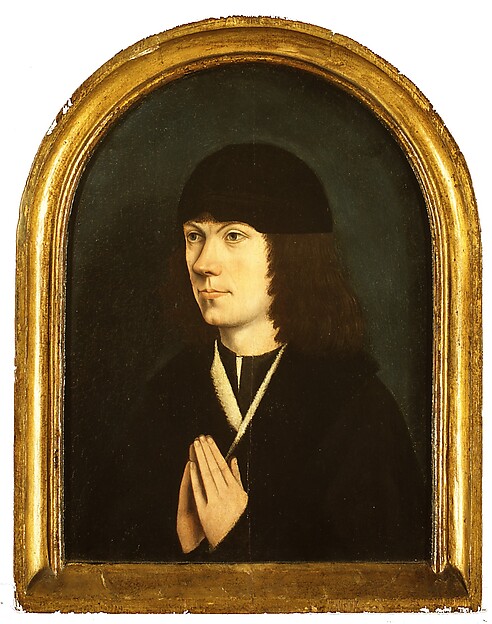 Portrait of a Young Man
 Altarpiece from Thuison-les-Abbeville: Saint Honoré
 Altarpiece from Thuison-les-Abbeville: The Ascension
 Panels from the High Altar of the Charterhouse of Saint-Hono
 The Nymph of Fontainebleau
More like this
 Italian; Sicily — Casket
 India
Deccan — Fitted Chest with Floral and Grape-Leaf Motif
India
Deccan — Fitted Chest with Floral and Grape-Leaf Motif South German; Nuremberg — Casket
 anonymous — Reliekkistje
 Roeloff Pietersz. van Vriese — Knottekist van verguld zilver
 Florence, Italy — Box
 Russia or England — Coffer
 German — Casket
 Italian — Casket
 Erhard & Söhne — Box
 China — Cloud-Shaped Pillow
 Nevers, France — Casket